I have spent my working life around people who know food. Market vendors, brigade cooks, foragers, farmers. In Borneo, I met a forager who knows more about the forest pantry than any of them, who never said a word.
In January 2026 I travelled to Tanjung Puting National Park in Central Kalimantan, on the Indonesian side of Borneo. To reach it, you leave the roads behind and go by boat up the Sekonyer River, deep into the forest, where the trees close in on both banks until the sky becomes a thin strip overhead. This is one of the great orangutan refuges of the world. Camp Leakey, the research station inside the park, was founded in 1971, and it is where Dr. Birutė Galdikas carried out her pioneering work on orangutan behaviour. There is no menu here, no market stall, no kitchen. Just one of the richest larders on Earth, and very few creatures who know how to read it.
The Person of the Forest
The name says everything. In Malay and Indonesian, orang hutan means "person of the forest." Stand in front of one and you understand why nobody has improved on it.
The Bornean orangutan is one of our closest living relatives, a great ape that spends most of its life in the trees. Researchers who study its diet count more than 400 different foods: wild figs, durian, leaves, seeds, flowers, bark, honey, even fungi. It knows which tree will fruit, when, and how far it has to travel to reach it before anyone else does.
As a chef, that stopped me. We talk about seasonality as if we invented it. Here was an animal that has been cooking with the seasons, so to speak, for its whole existence, without a calendar, a supplier or a cold room.
Then One Walked Out of the Trees
You expect to see orangutans high in the canopy, a flash of red-brown among the leaves. Bornean orangutans do travel on the ground more than their Sumatran cousins, but knowing that is one thing. Watching one step out of the forest and onto the path in front of you is something else entirely.
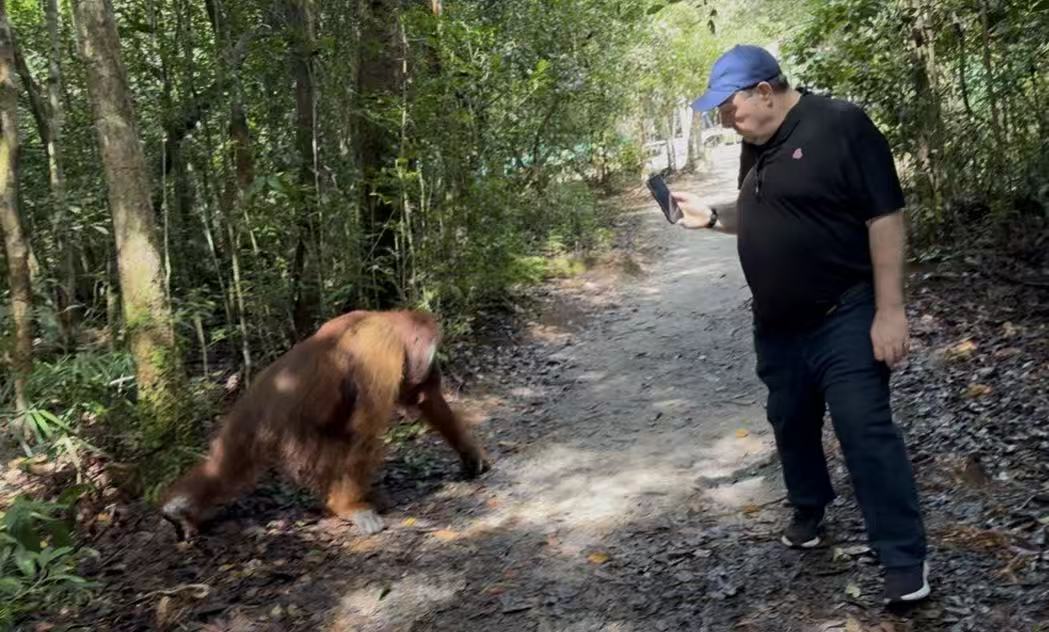
There is no rush in the way they move. Every step looks considered, as if the ground is being tested before the weight goes down. I filmed, and I kept still. When an animal that strong is that close, you very quickly understand who is the guest.
The Face You Do Not Forget
Then came the one everyone hopes for: a fully grown, flanged male.
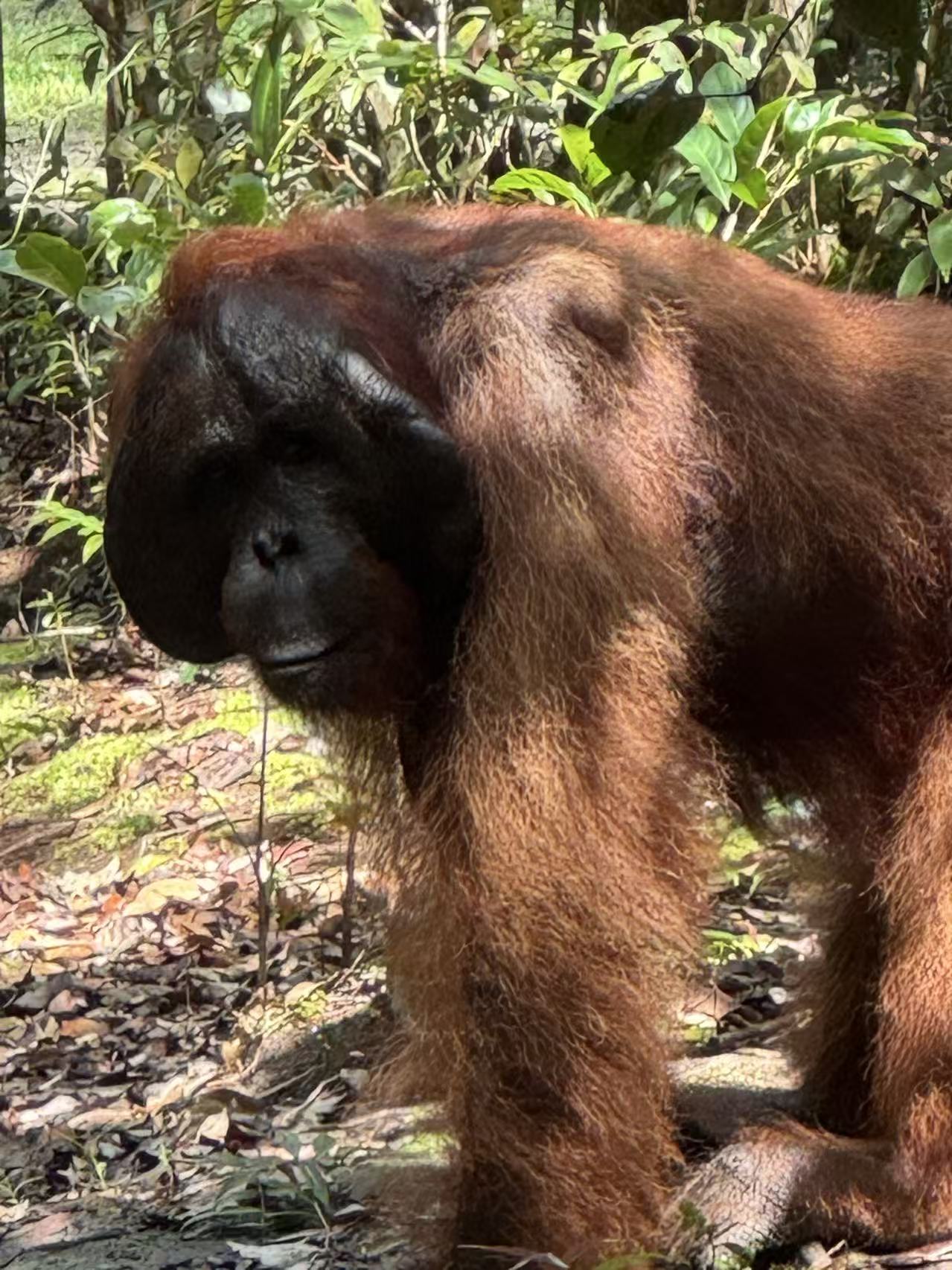
Those great cheek pads, the flanges, are carried only by adult males, and they make the face look almost carved. Up close, what you notice is not the size. It is the calm. He looked as though he had already seen everything worth seeing and was deciding whether we qualified.
In more than thirty years of kitchens, inspections and critics, I have rarely felt as thoroughly assessed as I did in front of that face.
What a Chef Takes Home From the Forest
Here is the part that stays with me, and it is not a comfortable one.
The Bornean orangutan is listed as critically endangered. Roughly 104,700 remain in the wild, a fraction of what the population was not long ago. The main threats are deforestation, hunting and the spread of palm oil plantations into the forest they live in.
Palm oil. One of the most common fats in the modern food industry, in products sitting in kitchens and supermarkets everywhere. The forest that feeds the person of the forest is being cleared, in part, to feed us.
I am not going to tell anyone how to shop. But I will say that after Borneo, I read labels differently, and I think about sourcing differently. A kitchen is only as honest as the ingredients that come through its back door.
Why This Belongs in a Chef's Journal
Travel has always been part of how I learned to cook. Markets taught me balance. Street vendors taught me speed. Borneo taught me something older: that the original pantry was never a shop. It was a forest, and somebody had to know it by heart.
That respect for where ingredients come from runs through everything I cook and everything I write.
The same care for ingredients, and for what happens when French technique meets the fire of Asia, is at the heart of French Knife, Asian Fire — Volume I: The Wok & The Whisk: thirty-five recipes written for a real home kitchen. Available now in paperback and on Kindle.
Prefer Kindle? Get the ebook here →
— Chef David Marteau
World Master Chef
Chevalier, Ordre du Mérite Agricole
Sources. Conservation status, population estimate, diet and threats for the Bornean orangutan (Pongo pygmaeus) from the IUCN Red List assessment and standard references; Tanjung Puting National Park and Camp Leakey from standard references. Photos by Chef David Marteau.
Know someone who would enjoy this story? Send it their way. That is how a small, independent kitchen journal finds its readers. Thank you for reading.
Éditions Marteau is an independent publisher, supported by its readers. Subscribe free to get new stories, recipes and kitchen notes by email, starting with my guide, 10 Techniques.
Thank you. Check your inbox and confirm your email to start receiving the newsletter.